In my recent project, there are at least eight liquid storage tanks we need to design and purchase. Although, the design of storage tank is not part of my work (it is a job of mechanical engineers), but I always wonder how people design the tanks. In this post, I want to share to you the results of my desktop study about liquid storage tank selection. Read More
Calculation of Water Spray for Fire Protection of Vertical Vessel
I just got an assignment from my boss to calculate fire protection of vertical vessel. NFPA 15 (National Fire Protection Association 15) is a standard for water spray fixed system for fire protection.
Definition
As per NFPA 15, water spray refer to the use of water in a form of having a predetermined pattern, particle size, velocity, and density discharged from specially designed nozzle devices. Read More
Condensate Load Calculation
I just read some pages on Handbook of Chemical Engineering Calculations 2nd edition, written by Nicholas P. Chopey and got interested in calculation of condensate load in order to determine the capacity of steam trap. I will take one example, where the steam indirectly heats a liquid through metallic surface, as in heat exchanger and kettles.
Case I
For example, we have 1892.5 L of water heated in 30 min from 22.2 to 100 oC with 50-psig (344.7-kPa) steam in the jacket of kettle. How much condensate formed?
For normal warm up load, the quantity of condensate can be calculated by the following equation: Read More
IP Codes
The IP Codes, Ingress Protection Rating, sometimes also interpreted as International Protection Rating, classifies and rates the degree of protection provided against the intrusion of solid objects (including body parts like hands and fingers), dust, accidental contact, and water in mechanical casings and with electrical enclosures.
A two-digit number established by the International Electro Technical Commission, is used to provide an Ingress Protection rating to a piece of electronic equipment or to an enclosure for electronic equipment.
The protection class after EN60529 are indicated by short symbols that consist of the two code letters IP and a code numeral for the amount of the protection.
Example: IP65 (NEMA 4)
The two digits represent different forms of environmental influence:
- The first digit represents protection against ingress of solid objects.
- The second digit represents protection against ingress of liquids.
The larger the value of each digit, the greater the protection. As an example, a product rated IP54 would be better protected against environmental factors than another similar product rated as IP42.
| Factor | Sedimentation | Filtration |
|---|---|---|
| Solid size, fine | x | |
| Solid size, > 150 micron | x | |
| Compressible cakes | x | |
| Open cakes | x | |
| Dry cake required | x | |
| High filtrate clarity | x | |
| Crystal breakage problems | x | |
| Pressure operation | ||
| High-temperature operation | will depend on the type of centrifuge used | will depend on the type of centrifuge used |
References:
- IP ratings. http://www.mpl.ch/info/IPratings.html
- IP code. http://en.wikipedia.org/wiki/IP_Code
Sizing of Expansion Tank for Hot Oil System
I want to share my experience about sizing of expansion tank especially for thermal oil heater. It is quite simple actually. I will give you an example.
Function of Expansion Tank
The functions of expansion tank are:
- Serves as the safe outlet for the increase in thermal fluid volume due to thermal expansion
- Provides a mechanism for venting water, incondensibles, degradation by products and entrained air during start-up and operation
Sizing Expansion Tank

When selecting an expansion tank, the system volume (including the initial fill) of the expansion tank, the operating temperature and the fluid’s coefficient of thermal expansion should all be considered. Because thermal oils expand at different rates, the expansion tank capacity always should be verified against the oil properties prior to filling the system. Read More
Chemical Engineer’s Diary: It is not easy to be an engineer
Sometimes, I feel involving in EPC project was such a chaos, totally messed up. The advantages of involving in low-cost project, such as feasibility study, is we are working in a small group of people. It is very easy to coordinate or to communicate, even to share information or transfer knowledge. EPC project is totally different. It involves many departments and involves other people outside the company, such as vendors. Read More
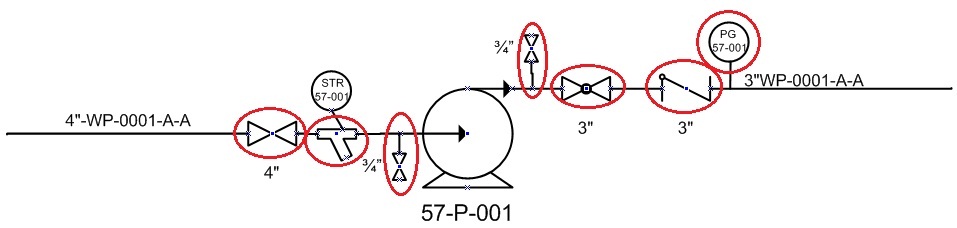
Typical Configuration of Pump in Piping and Instrumentation Diagram (P&ID)
Since I have involved in the current project, which is EPC project, I always want to make some short writing and simple guideline to create piping and instrumentation diagram (P&ID) for several equipments, such as pump, tank, vessel, compressor, and so on. This post will be my first post on simple guideline related to configuration of pump in piping and instrumentation diagram.

Figure above reprsents typical piping and instrumentation diagram of pump. Pump should have:
- Pump Symbol. Make sure you use proper pump symbol. As for example above, I use centrifugal pump. Check your P&ID legend
- All the nozzles should be correctly represented with size and flanges. Generally, the suction and discharge nozzles on the pump are smaller than suction and discharge line sizes. Appropriate reducer / expander to be clearly indicated in such cases.
- Strainer. In the example above, I install Y-strainer. The strainer is used to separate debris from the liquid
- Check valve. Check valve shall be installed to prevent liquid flow reversal with the succession of pumping
- Globe valve. Globe valve installed at discharge line to regulate the flow of liquid
- Pressure gauges are normally to be provided on suction and discharge line
- Inlet and outlet lines are the next to be drawn up. Line number, material class, size, pressure rating, etc. is to be correctly assigned to each of the lines.
- Drains and vents to be provided on the suction / discharge lines
Energy Saving: Its Background

I think the issue in energy saving is getting hotter day by day. A lot of seminars and training were held to create awareness among people to take action on energy saving.When I was pursuing master degree, I took bioenergy as theme of my thesis. I was getting aware on energy depletion, so that it couraged scientists in the world to develop alternative energy to replace petroleum oil. Honestly, the idea of saving energy is pretty new for me although the background is the same as developing alternative energy.
Increasing Demand, Decreasing Supply
Global primary demand is projected to increase by 53% between 2004 and 2030 to over 17 million TOE (ton oil equivalent) – an average annual rate of 1.6%. Over 70% of the increase comes from developing countries. The power generation sector contributes close to one-half of the global increase (source).
Fossil fuel is the dominant source of energy, accounting for 83% of the overall increase in energy demand. For example, oil demand grows by 1.3% annually, reaching 116 million barrel per day in 2030.
No one doubts that fossil fuels are subject to depletion. The availability of oil worldwide has already peaked (source).
One report said that the amount of proved oil left in the world was 1.15 trilion barrels. It would take 41 years for this to be completed. As for gas, the remaining proved reserves was 176 trilion cubic meters or 67 years’ worth of supplies (source).
Increasing Energy Price
Energy price is expected to increase in short and long-term basis. There are several drivers of energy price. The drivers are
- Demand
- Reserves
- Costs
- Market power (source)
For example, due to declining reserves, oil and gas costs will increase.
Due to the reasons above, the idea of saving energy is very important.
Creating Piping and Instrumentation Diagram: My Real Experiences

As already described in previous posts (such as here and here), I was involved in EPC project. Creating piping and instrumentation diagram (P&ID) is one of my responsibility. I think P&ID is a collection of information and collaboration of every discipline, such as process, mechanical, electrical, and instrumentation. Once I think creating P&ID is easy enough, but I change my mind then. It is not.
I revised my P&ID (water treatment plant, fuel supply system, and wastewater treatment plant) several times. I am not quite sure if I am a kind of diligent person, but I am sure creating “perfect P&ID” requires a lot of works and patience. I sometimes think there’s nothing wrong with my P&ID. However, if you let someone, for example your colleagues, your boss, or someone with more experiences than you to check your P&ID, you will laugh at yourself. It happened to me. My P&ID was far from perfect. I understand now. Perfect P&ID requires continuous improvement. Read More
Thermal Oil Heater
My current job is to select vendor who will supply thermal oil heater. It is pretty hard work for me because I did not involve in thermal oil heater design since the beginning. Unlike water treatment plant which I deeply learnt since the beginning, I even don’t have any idea about thermal oil heater, so I need to learn harder. Since I am not a fast learner, I write this post as the methode (which I like the most) for me to understand what thermal oil heater is and how to select appropriate thermal oil heater. Read More