
Where to install pressure gauge at pump discharge line

Yesterday I had enough time to increase my basic knowledge in chemical engineering because I had finished my works. Then, I stumbled upon this link and started to think about my piping and instrumentation diagram. I realized I had make a fundamental mistakes. I felt useless.

I am writing this post so that I will remember my mistakes and never try to do it again. Hope you find it useful.

Remember everyone! Pressure gauge shall be installed after pump discharge nozzle and before check valve. The consequence is if you have two pumps (one is running and another is stand by, then you have to install two pressure gauge). The reason is:

  • To show actual pump discharge pressure. If you install pressure gauge after check valve, the value of discharge pressure won’t be actual due to pressure loss of check valve
  • In the case of check valve failure, pressure gauge will show actual discharge pressure. If the pump has problem, pressure gauge will show pressure value lower than usual
Storage Tank Selection

In my recent project, there are at least eight liquid storage tanks we need to design and purchase. Although, the design of storage tank is not part of my work (it is a job of mechanical engineers), but I always wonder how people design the tanks. In this post, I want to share to you the results of my desktop study about liquid storage tank selection. Read More

IP Codes

The IP CodesIngress Protection Rating, sometimes also interpreted as International Protection Rating, classifies and rates the degree of protection provided against the intrusion of solid objects (including body parts like hands and fingers), dust, accidental contact, and water in mechanical casings and with electrical enclosures.

A two-digit number established by the International Electro Technical Commission, is used to provide an Ingress Protection rating to a piece of electronic equipment or to an enclosure for electronic equipment.

The protection class after EN60529 are indicated by short symbols that consist of the two code letters IP and a code numeral for the amount of the protection.

Example: IP65 (NEMA 4)
The two digits represent different forms of environmental influence:

  •  The first digit represents protection against ingress of solid objects.
  •  The second digit represents protection against ingress of liquids.

The larger the value of each digit, the greater the protection. As an example, a product rated IP54 would be better protected against environmental factors than another similar product rated as IP42.

FactorSedimentationFiltration
Solid size, finex
Solid size, > 150 micronx
Compressible cakesx
Open cakesx
Dry cake requiredx
High filtrate clarityx
Crystal breakage problemsx
Pressure operation
High-temperature operationwill depend on the type of centrifuge usedwill depend on the type of centrifuge used

References:

  1. IP ratings. http://www.mpl.ch/info/IPratings.html
  2. IP code. http://en.wikipedia.org/wiki/IP_Code

Typical Configuration of Pump in Piping and Instrumentation Diagram (P&ID)

Since I have involved in the current project, which is EPC project, I always want to make some short writing and simple guideline to create piping and instrumentation diagram (P&ID) for several equipments, such as pump, tank, vessel, compressor, and so on. This post will be my first post on simple guideline related to configuration of pump in piping and instrumentation diagram.

Typical Configuration of Pump on PID

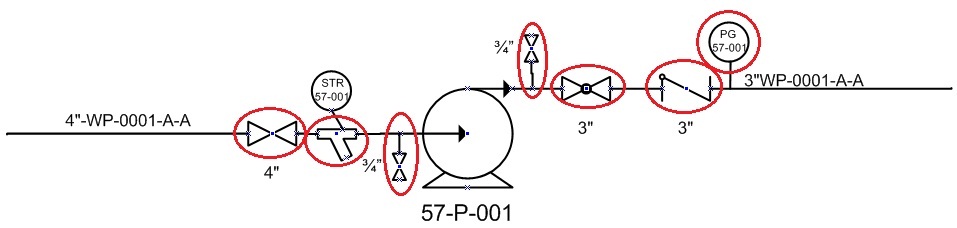
Figure above reprsents typical piping and instrumentation diagram of pump. Pump should have:

  1. Pump Symbol. Make sure you use proper pump symbol. As for example above, I use centrifugal pump.  Check your P&ID legend
  2. All the nozzles should be correctly represented with size and flanges. Generally, the suction and discharge nozzles on the pump are smaller than suction and discharge line sizes. Appropriate reducer / expander to be clearly indicated in such cases.
  3. Strainer. In the example above, I install Y-strainer. The strainer is used to separate debris from the liquid
  4. Check valve. Check valve shall be installed to prevent liquid flow reversal with the succession of pumping
  5. Globe valve. Globe valve installed at discharge line to regulate the flow of liquid
  6. Pressure gauges are normally to be provided on suction and discharge  line
  7. Inlet and outlet lines are the next to be drawn up. Line number, material class, size, pressure rating, etc. is to be correctly assigned to each of the lines.
  8. Drains and vents to be provided on the suction / discharge lines

Source.

Creating Piping and Instrumentation Diagram: My Real Experiences

Example of P&ID
http://www.engineeringtoolbox.com/p-id-piping-instrumentation-diagram-d_466.html

As already described in previous posts (such as here and here), I was involved in EPC project. Creating piping and instrumentation diagram (P&ID) is one of my responsibility. I think P&ID is a collection of information and collaboration of every discipline, such as process, mechanical, electrical, and instrumentation. Once I think creating P&ID is easy enough, but I change my mind then. It is not.

I revised my P&ID (water treatment plant, fuel supply system, and wastewater treatment plant) several times. I am not quite sure if I am a kind of diligent person, but I am sure creating “perfect P&ID” requires a lot of works and patience. I sometimes think there’s nothing wrong with my P&ID. However, if you let someone, for example your colleagues, your boss, or someone with more experiences than you to check your P&ID, you will laugh at yourself. It happened to me. My P&ID was far from perfect. I understand now. Perfect P&ID requires continuous improvement. Read More

Plant Layout Consideration

About a week ago my boss asked me something crucial about Plant Conceptual Design and Layout for our bankable feasibility study of ferronickel project. He asked me if I had explained why we chose this part as smelter plant and not on that part, why the gate should be on the west side of the processing plant, and so on. I just shook my head and grinning. BIG NO! 

My boss was emphasizing the philosophy to make site plan. There are several considerations to make site plan. For example, the processing facilities which are heavy, require high load, and very dynamic, should be positioned at the relatively flat and so on.

I started to think what aspects we need to consider making plant layout. Read More